EuroGamersOnline The Different Types
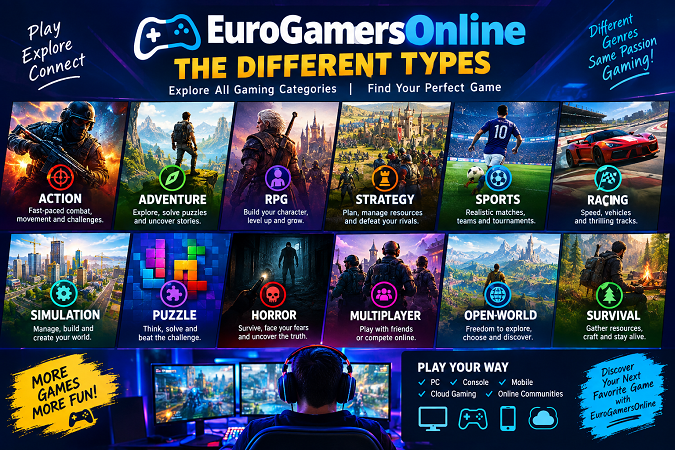
The gaming world has expanded far beyond traditional console and PC games. Today, players can explore competitive esports, mobile games, online multiplayer experiences, strategy titles, role-playing adventures, simulation games, and many other formats. As gaming communities continue to grow, platforms and gaming-focused websites are increasingly organising games into different categories to help players discover experiences that match their interests.The phrase “eurogamersonline the different types” can be understood as an exploration of the different types of gaming experiences associated with EuroGamersOnline and the wider online gaming environment. Understanding these categories can make it easier for new and experienced players to identify the games, features, and communities they are most interested in.
This guide explores the major gaming types, how they work, what makes each category different, and what players should consider when choosing an online gaming experience.
Also Read: Gaming News EteSportech From ETrueSports
What Does EuroGamersOnline the Different Types Mean?
The term eurogamersonline the different types refer broadly to the variety of gaming categories that players may encounter in an online gaming ecosystem. Rather than focusing on one particular genre, the concept covers multiple forms of digital entertainment.
Different games are designed around different experiences. Some emphasise competition, while others focus on storytelling. Some require quick reactions, while others reward planning and patience. There are also games designed primarily for social interaction, exploration, creativity, or realistic simulation.
For this reason, understanding game types is useful when searching for new titles. A player who enjoys strategic thinking may prefer strategy games, while someone looking for a short gaming session might choose a casual mobile title.
Why Are Different Gaming Types Important?
The huge number of games available today makes categorisation increasingly useful. Game genres provide players with a simple way to understand what they can expect from a title.
For example, an action game generally emphasises movement and quick decisions. A role-playing game may focus on character development, exploration, and narrative. A sports game attempts to recreate athletic competitions digitally, while a simulation game may reproduce real-world activities.
Game categories also help gaming communities communicate. Players can discuss their favorite genres, discover similar titles, and find communities that share their interests.
1. Action Games
Action games are among the most recognisable categories in gaming. These titles generally emphasize quick reactions, movement, timing, and direct interaction.
Players may need to overcome enemies, complete challenges, avoid obstacles, or accomplish objectives within a limited amount of time. Many action games combine combat with exploration and progression.
This category can include several subgenres, such as platformers, beat-’em-ups, fighting games, and action-adventure titles.
Key Characteristics
- Fast-paced gameplay
- Quick reactions
- Combat or physical challenges
- Levels and objectives
- Increasing difficulty
- Skill-based progression
Action games can be suitable for players who enjoy energetic and interactive gameplay.
2. Adventure Games
Adventure games generally emphasise exploration, discovery, storytelling, and problem-solving. Instead of focusing exclusively on fast combat, these games often encourage players to investigate environments and uncover information.
Some adventure titles feature puzzles, dialogue systems, branching stories, and exploration mechanics.
Adventure games can provide a more relaxed experience while still giving players meaningful objectives. They are particularly attractive to gamers who enjoy discovering fictional worlds and following narratives.
3. Role-Playing Games
Role-playing games, commonly called RPGs, allow players to control characters who develop throughout a game.
Character progression is one of the defining elements of RPGs. Players may gain experience, unlock abilities, acquire equipment, improve statistics, or make decisions that affect the story.
Many RPGs also feature extensive worlds filled with quests, characters, locations, and optional activities.
Common RPG Features
- Character customisation
- Experience and levelling
- Equipment systems
- Quests
- Story-driven gameplay
- Exploration
- Skill development
Some RPGs are designed for single-player experiences, while others include online multiplayer features.
4. Strategy Games
Strategy games reward planning, decision-making, resource management, and long-term thinking.
Players may control armies, civilisations, businesses, teams, or other systems. Success often depends less on reaction speed and more on understanding available resources and anticipating future situations.
Strategy games can be divided into several formats, including real-time strategy and turn-based strategy.
Real-time strategy games require players to make decisions while the game continues to operate. Turn-based strategy games give players more time to analyse situations before making decisions.
5. Sports Games
Sports games digitally recreate real-world sporting activities. Popular themes include football, basketball, racing, tennis, cricket, and many other sports.
These games can provide both single-player and multiplayer experiences. Players may compete against computer-controlled opponents or other people online.
Sports games often include team management, player customisation, tournaments, career modes, and competitive online modes.
For sports fans, these games can combine familiar athletic concepts with interactive digital entertainment.
6. Racing Games
Racing games focus on speed, vehicles, tracks, and competition. They can range from highly realistic driving simulations to arcade-style experiences.
Simulation-orientated racing games often attempt to reproduce realistic vehicle handling, physics, and track conditions. Arcade racing games usually prioritise accessibility and excitement.
Online racing can also introduce competitive leaderboards, multiplayer competitions, tournaments, and rankings.
7. Simulation Games
Simulation games attempt to reproduce real-world or fictional systems. The player may operate a vehicle, manage a city, build a business, maintain a farm, or control another complex environment.
The main attraction is often the ability to experiment with systems and make decisions.
Simulation games can be highly detailed, making them attractive to players who enjoy realistic or methodical gameplay.
8. Puzzle Games
Puzzle games focus primarily on logical thinking, pattern recognition, problem-solving, and observation.
They can be simple enough for short gaming sessions or complex enough to challenge experienced players.
Puzzle games are especially common on mobile devices because many can be played in short sessions. However, the category also includes large PC and console experiences.
Common puzzle mechanics include:
- Matching
- Logic problems
- Spatial challenges
- Word puzzles
- Number-based challenges
- Pattern recognition
- Physics-based puzzles
9. Multiplayer Online Games
Multiplayer online games allow players to interact with other people through an internet connection.
These games can include competitive matches, cooperative missions, open-world exploration, social spaces, and team-based activities.
Online multiplayer has transformed gaming into a social experience. Instead of playing only against computer-controlled opponents, players can communicate and cooperate with people from different locations.
10. Battle Royale Games
Battle royale games typically place multiple players or teams into a competitive environment where participants attempt to survive and become the final remaining player or team.
Many battle royale games feature resource collection, equipment management, changing play areas, and strategic positioning.
The genre became especially popular because it combines competition, unpredictability, and replayability.
11. Multiplayer Online Battle Arena Games
Multiplayer Online Battle Arena games, commonly called MOBAs, usually involve teams competing against one another on structured maps.
Players typically control individual characters with unique abilities. Team coordination is an important part of the experience.
Successful teams often need to communicate, manage objectives, understand character roles, and react to changing situations.
12. First-Person and Third-Person Games
Another useful way to categorise games is by perspective.
First-person games display the world from the character’s viewpoint. This perspective is frequently used in shooting, horror, and immersive adventure games.
Third-person games display the player’s character from an external camera position. This can provide greater awareness of the surrounding environment and character movement.
Both perspectives can support action, adventure, RPG, survival, and multiplayer experiences.
13. Mobile Games
Mobile gaming has become one of the largest areas of digital entertainment. Smartphones and tablets allow people to play games almost anywhere.
Mobile games range from simple puzzle experiences to complex multiplayer titles with advanced graphics.
Many mobile games are designed around shorter sessions, although some offer experiences comparable to traditional PC and console games.
Important considerations for mobile gaming include device compatibility, storage requirements, internet usage, battery consumption, and in-game purchasing systems.
14. Esports and Competitive Gaming
Esports refers to organised competitive gaming. Professional players and teams can participate in tournaments featuring structured rules, rankings, broadcasts, and prizes.
Competitive gaming requires more than simply understanding game mechanics. Players often practice specific strategies, study opponents, communicate with teammates, and analyse previous matches.
The growth of esports has also created opportunities for commentators, coaches, tournament organisers, content creators, analysts, and other professionals.
15. Casual Games
Casual games are generally designed to be easy to understand and accessible to a broad audience.
They may feature straightforward controls, short levels, and simple objectives. Casual games can be particularly convenient for players who do not want to spend hours learning complicated systems.
Despite their simplicity, some casual games offer substantial depth and long-term progression.
16. Sandbox and Open-World Games
Sandbox games give players considerable freedom to explore, create, build, or experiment.
Open-world games can similarly provide large environments where players choose their own activities rather than following a strictly linear path.
These games are popular among players who enjoy freedom and experimentation. Some focus heavily on construction and creativity, while others combine open exploration with missions and narrative content.
17. Horror Games
Horror games are designed to create tension, suspense, uncertainty, or fear.
They may use atmospheric environments, sound design, limited resources, mysterious stories, or unexpected events to create an emotional experience.
Some horror games are single-player experiences, while others introduce cooperative multiplayer mechanics.
For players interested in immersive storytelling and suspense, horror can provide a very different experience from competitive genres.
Comparison Table: Different Types of Online Games
| Game Type | Main Focus | Typical Skills | Suitable For |
|---|---|---|---|
| Action | Fast gameplay | Reaction and timing | Competitive players |
| Adventure | Exploration and story | Observation | Story-focused players |
| RPG | Character development | Planning and exploration | Long-term players |
| Strategy | Planning | Decision-making | Tactical thinkers |
| Sports | Athletic competition | Timing and strategy | Sports fans |
| Racing | Speed and driving | Reflexes | Racing enthusiasts |
| Simulation | Realistic systems | Management | Detail-orientated players |
| Puzzle | Problem-solving | Logic | Brain-training fans |
| Battle Royale | Survival competition | Strategy and reactions | Competitive players |
| MOBA | Team competition | Coordination | Team-orientated players |
| Mobile | Accessible gameplay | Varies | On-the-go players |
| Esports | Organised competition | Advanced game skills | Competitive gamers |
| Casual | Simple entertainment | Basic interaction | Beginners |
| Sandbox | Creativity and freedom | Experimentation | Creative players |
| Horror | Suspense and fear | Observation | Horror fans |
How to Choose the Right Gaming Type: EuroGamersOnline the Different Types
Choosing a game genre depends largely on personal preferences. There is no single category that suits every player.
First, consider how much time you normally have available. If gaming sessions are short, casual, puzzle, or mobile, games may be convenient. Players with more time may prefer RPGs, strategy games, or large online worlds.
Next, consider whether you enjoy competition. Players who like competing against others may prefer esports, battle royale games, racing games, or multiplayer titles.
Storytelling is another important factor. Adventure and RPG games often provide deeper narrative experiences, while competitive games may focus more heavily on gameplay mechanics.
Hardware should also be considered. Some games require powerful PCs or modern consoles, while others can run on smartphones or less demanding systems.
The Role of Online Communities: EuroGamersOnline the Different Types
One of the most important developments in modern gaming is the growth of online communities.
Players can discuss games, share strategies, create videos, stream gameplay, participate in tournaments, and communicate with other fans.
Gaming communities can make an individual game more engaging because players are no longer experiencing the title alone. They can learn from others and participate in shared events.
However, responsible online behaviour is important. Players should protect personal information, use strong account security, avoid suspicious downloads, and follow community guidelines.
Gaming Platforms and Accessibility: EuroGamersOnline the Different Types
Modern games are available across many platforms. PCs, consoles, smartphones, tablets, and cloud-based services can all provide gaming experiences.
Cross-platform development has also become increasingly common. Depending on the specific title, players on different devices may be able to participate in the same online environment.
Accessibility features are another important part of modern gaming. Adjustable controls, subtitles, visual settings, audio options, and difficulty adjustments can make games more accessible to a wider audience.
Benefits of Exploring Different Game Types: EuroGamersOnline the Different Types
Exploring different genres can help players discover experiences they might not otherwise try.
A player who normally prefers action games may discover an interest in strategy titles. Someone who usually plays competitive multiplayer games may enjoy a narrative-focused RPG.
Different genres also encourage different skills. Strategy games can encourage planning, puzzle games can challenge logical thinking, and multiplayer games can encourage communication and teamwork.
The key is to treat genres as a way of discovering possibilities rather than strict categories. Many modern games combine several genres.
The Future of Online Gaming: EuroGamersOnline the Different Types
Online gaming continues to evolve as technology develops. Faster internet connections, improved hardware, cloud technologies, artificial intelligence, virtual reality, and augmented reality may influence how games are designed and played.
Future games may combine traditional genres in new ways. A single title might include RPG progression, strategy mechanics, multiplayer competition, simulation elements, and an open-world environment.
This increasing combination of features means that traditional genre labels may become less restrictive over time.
(FAQs): About EuroGamersOnline the Different Types
What does “eurogamersonline the different types” mean?
The phrase can refer to exploring different types or categories of online gaming associated with the EuroGamersOnline topic. It can include genres such as action, RPG, strategy, sports, simulation, mobile, multiplayer, and esports.
What are the main types of online games?
Major categories include action, adventure, RPG, strategy, sports, racing, simulation, puzzle, battle royale, MOBA, casual, horror, sandbox, and multiplayer games.
Which gaming genre is best for beginners?
There is no universal best genre. Beginners may find casual, puzzle, adventure, or accessible mobile games easier to learn because many offer straightforward controls and objectives.
What are esports games?
Esports games are titles played competitively in organised tournaments or leagues. They can involve individual competitors or teams.
Are mobile games considered online games?
Some mobile games are entirely offline, while others use internet connections for multiplayer, updates, social features, or online services. Therefore, mobile gaming and online gaming are overlapping but not identical categories.
What is the difference between RPG and strategy games?
RPGs usually emphasise character development, exploration, abilities, equipment, and storytelling. Strategy games primarily emphasise planning, resource management, tactical decisions, and long-term objectives.
Why are multiplayer games popular?
Multiplayer games allow people to compete or cooperate with other players. Social interaction, competition, teamwork, and replayability are major reasons for their popularity.
What should I consider before choosing an online game?
Consider the genre, platform, hardware requirements, internet connection, gameplay style, age rating, community features, pricing, and whether you prefer single-player or multiplayer experiences.
Can one game belong to multiple genres?
Yes. Many modern games combine several genres. A game could simultaneously include RPG progression, open-world exploration, action combat, and multiplayer features.
How can I discover new gaming genres?
Try games outside your usual preferences, read detailed reviews, watch gameplay demonstrations, explore gaming communities, and experiment with free or low-cost titles when available.
Conclusion: EuroGamersOnline the Different Types
Understanding eurogamersonline the different types provides a useful starting point for exploring the wider gaming landscape. From action and adventure to RPG, strategy, simulation, mobile, esports, and multiplayer gaming, each category offers a distinct experience.
The best genre for an individual player depends on personal interests, available time, preferred platform, and desired level of competition. Exploring several categories can help gamers discover new experiences and better understand what makes different games enjoyable.
As gaming technology continues to develop, the boundaries between genres will likely become increasingly flexible. For players, that means there will continue to be new ways to explore, compete, create, and connect through digital entertainment.
About the Author